Ten years since the momentous Paris Agreement was signed at COP21, the world stands at a pivotal crossroads – and global climate and atmospheric data tell the story. 2024 saw atmospheric concentrations of carbon dioxide and methane reach new record levels; it was our warmest year on record, exceeding 1.5oC above pre-industrial levels; and a large number of extreme events were recorded across the globe, including heatwaves, floods, droughts and wildfires.
As COP30 convenes in Belém, the Copernicus Climate Change Service (C3S) and Copernicus Atmosphere Monitoring Service (CAMS) have compiled data that reveal the climate and atmospheric signals that have defined this decisive decade.
The data produced by C3S and CAMS act as both a collective memory of our planet and as an indicator of where our climate could be headed. This enables governments, industries and communities to make targeted, science-driven choices – from anticipating the impacts of heat extremes and droughts in order to strengthen resilience, to assessing solar and wind intensity to plan renewable energy deployment. This open-access science-based data ensures that the decisions made in Belém can be grounded in the reality of our planet’s systems - measurable, traceable, and quality-assured.
Carlo Buontempo, Director of the Copernicus Climate Change Service, says:
“A decade after the Paris Agreement, the world is hotter than ever – every year since has ranked among the 10 warmest on record. It’s now evident that the climate is shifting at a pace humanity has never experienced. But we do have one superpower in our efforts to tackle climate change – a rich supply of timely scientific data, information and knowledge, all free open and available to everyone without restrictions. It’s this information that gives policy makers the power to respond with confidence and clarity in the face of rapid change. It is this evidence that must guide the delegates at COP30. The choices we make today will shape the planet’s future, forever. We must ensure those choices are grounded in facts.”
Laurence Rouil, Director of the Copernicus Atmosphere Monitoring Service, says:
“From air pollutants to greenhouse gas concentrations, our atmosphere is perhaps the most direct and immediate indicator of every action we take. Over the past decade, CO2concentrations have risen over 5%, reaching their highest annual levels ever recorded. CAMS monitor their evolution and track their sources. Aside fossil fuel emissions which accounted for almost 75% of total carbon emissions in 2024, wildfires already released more than 1300 megatonnes of carbon in 2025, and huge amounts of particulate matter that degrades air quality and have harmful impacts on human health. This 10-year benchmark is not only a milestone, but also a mirror – that reflects how progress over the last decade measures up to the ambitions of the Paris Agreement. The last decade has seen significant change, and the next decade will be decisive. But knowledge is power; and delegates at COP30 have more knowledge, data and understanding of our atmosphere than ever before – we encourage them to use this to turn ambition into action.”
Florence Rabier will be in Belém for COP30 and available to attend media enquiries between 10-13 November. To arrange an interview, please contact ECMWF press office atpressoffice@ecmwf.int.

In December 2015, during the signing of the Paris Agreement, the extrapolated data from our Global Temperature Trend application indicated that global warming had reached 1.04ºC above pre-industrial levels and would reach 1.5ºC by March 2042.
Today, based on September 2025 data,global warming is estimated to be 1.4ºC above pre-industrial levels and the 1.5ºC global warming threshold is estimated to be reached in May 2029. These levels coincide with a steady increase in greenhouse gas emissions during the last decade.
The past 10 years (2015–2024) were the 10 warmest on record.
Depending on what the global temperature in November and December turns out to be, 2025 will either be the second or third warmest year on record.
For the first time, it is possible that the 1.5°C threshold above the pre-industrial average for 1850–1900 will be exceeded for a period of three calendar years.
Greenhouse gases are on a steady rise and saw their highest annual levels ever recorded in the atmosphere in 2024.
Since the Paris Agreement was signed, carbon dioxide concentrations have increased by 5.64%, reaching 422 ppm in 2024. Over the same period, methane concentrations have increased by 5.33%, reaching1901 ppbin 2024.
In support of the Global Methane Pledge and UNEP’s International Methane Emissions Observatory, CAMS introduced theCAMS Methane Hotspot Explorer, a powerful tool that allows users to visualise major methane (CH₄) emission plumes from leaks and other anthropogenic sources worldwide with only a week delay.
The platform currently uses observations from the Copernicus Sentinel-5P satellite, but will be extended to other satellites, including from commercial missions. The tool can be used to monitor local scale methane emissions, including their mitigation, and detect new sources.
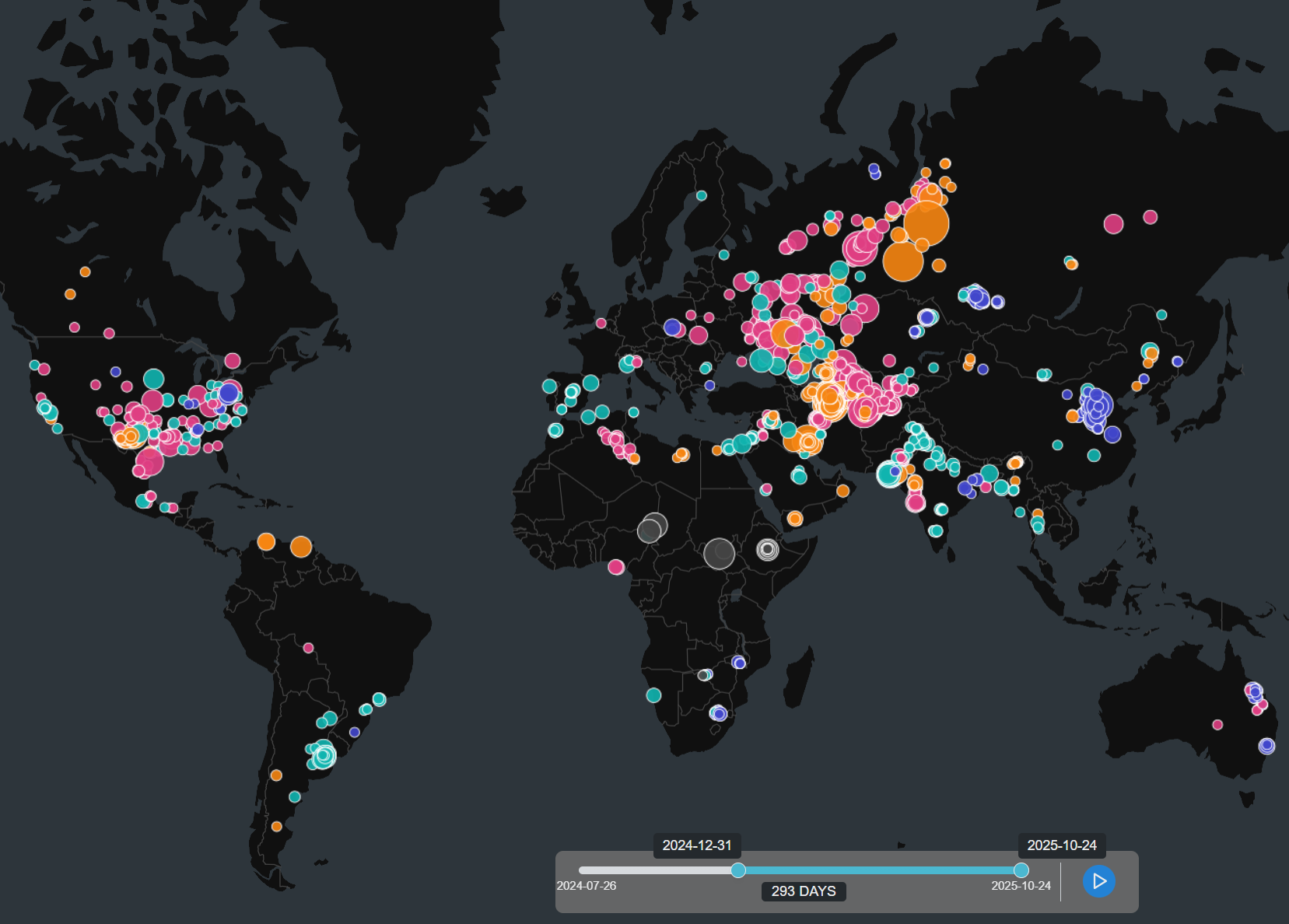
CAMS provides a 23-year dataset, updated in near-real time, of the location and estimated emissions of biomass burning (including wildfires and open burning) around the world based on satellite observations of Fire Radiative Power (FRP). The estimated emissions are subject to large uncertainties related to assumptions made in converting the observed FRP into the amount of fuel burned (including fuel type, shape and distribution) and subsequent emissions.
Biomass burning in tropical Africa makes the largest contribution to global biomass burning emissions, including the overall declining total over the past two decades related to reduced numbers of savanna fires. However, in other regions the data show increased emissions in recent years from North America (2023, 2024 and 2025) and the historic fire emissions from South America in 2024. The data show that, although there is a high degree of year-to-year variability, more extreme fire emissions have been increasing in recent years at different continental scales.
Explore our free data stores:
- Climate Data Store:https://cds.climate.copernicus.eu/
- Atmosphere Data Store:https://ads.atmosphere.copernicus.eu/
RELATED CONTENT
Climate Bulletins for October 2025
European State of the Climate 2024 report
Global Climate Highlights 2024