Bonn, 16/09/2024
3D rendering of the ozone hole evolution in 2024
CAMS total column ozone analyses over the South Pole between 01.07.2024 and 12.09.2024 (Source: CAMS/ECMWF).DOWLOAD HD ANIMATION
TheCopernicus Atmosphere Monitoring Service(CAMS) routinely monitors the atmospheric variables that impact the annual formation of the ozone hole over the South Pole and has observed that its development began later than average in 2024. This is mainly related to changes in the temperatures and wind patterns in the stratosphere in the region, leading to a delayed onset of the ozone-depletion process. 16 September marks the International Day for the Preservation of the Ozone Layer and commemorates the signature of the Montreal Protocol in 1987 on Substances that Deplete the Ozone Layer.
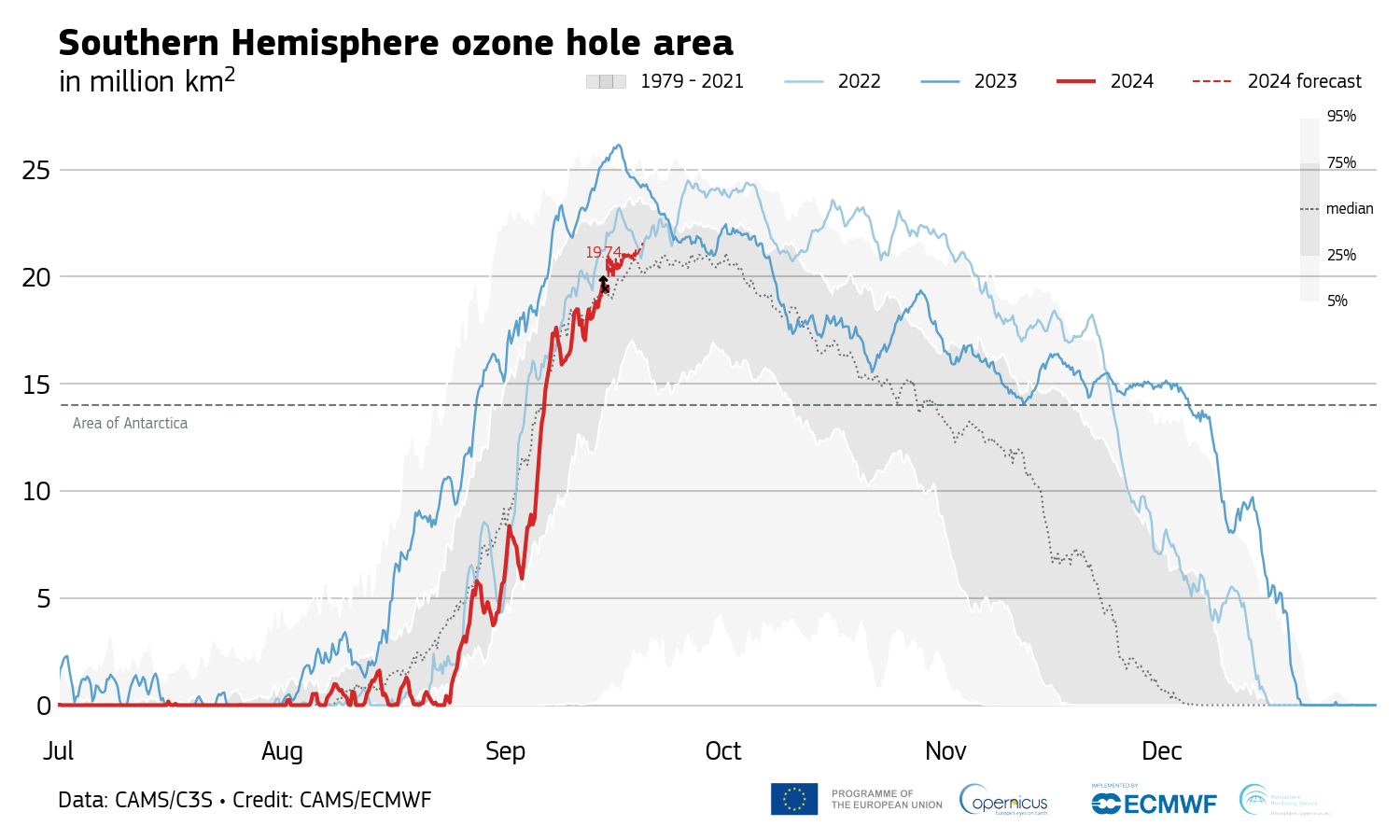
The Antarctic ozone hole refers to the chemical depletion of the stratospheric ozone layer in this part of the globe and is an atmospheric phenomenon that occurs each year during the Southern Hemisphere Spring. Under normal meteorological conditions the hole begins to form in mid- to late August, and it closes towards the end of November. The 2024 Antarctic ozone hole development started later than average, mainly due to disruptions in the polar vortex, following two episodes of sudden stratospheric warming in July.
As a result, CAMS data shows that total column ozone values over most of the Antarctic region have remained largely above 220 Dobson Units (DU) — the threshold value used to define the Antarctic ozone hole, for a longer period of time. By 13 September 2024, the total area of the ozone hole was 18.48 million km2, smaller than in recent years for this period.
Laurence Rouil, Director of the Copernicus Atmosphere Monitoring Service (CAMS)at ECMWF, says:“From volcanoes to climate change, there are a myriad of factors that play a role, directly or indirectly, in the formation of the Antarctic ozone hole. Nonetheless, none of them are as impactful as the anthropogenic ozone-depleting substances. The Montreal Protocol and subsequent amendments have created enough space for the ozone layer to begin healing, and we can expect further signs of recovery to be visible in the next forty years. This shows how humanity is capable, through international cooperation and science-based decision-making, to transform our impact on the planet’s atmosphere.”
The Montreal Protocol was created to protect the ozone layer by banning and controlling ozone depleting substances (ODS). This is widely regarded as a global collective success, as through it and the subsequent amendments that accelerated the commitment, further deterioration of the ozone layer was prevented, setting the path for recovery. It is important to highlight, nonetheless, that this late onset of the ozone hole is not by itself a sign of its recovery, but rather a consequence of the natural variability of the atmospheric factors that made its occurrence possible.
CAMS publishes up-to-date charts with analyses, forecasts, and animations of the ozone hole throughout the season onits monitoring page, which is updated on a regular basis with the most recent information on the topic.