3rd October 2025
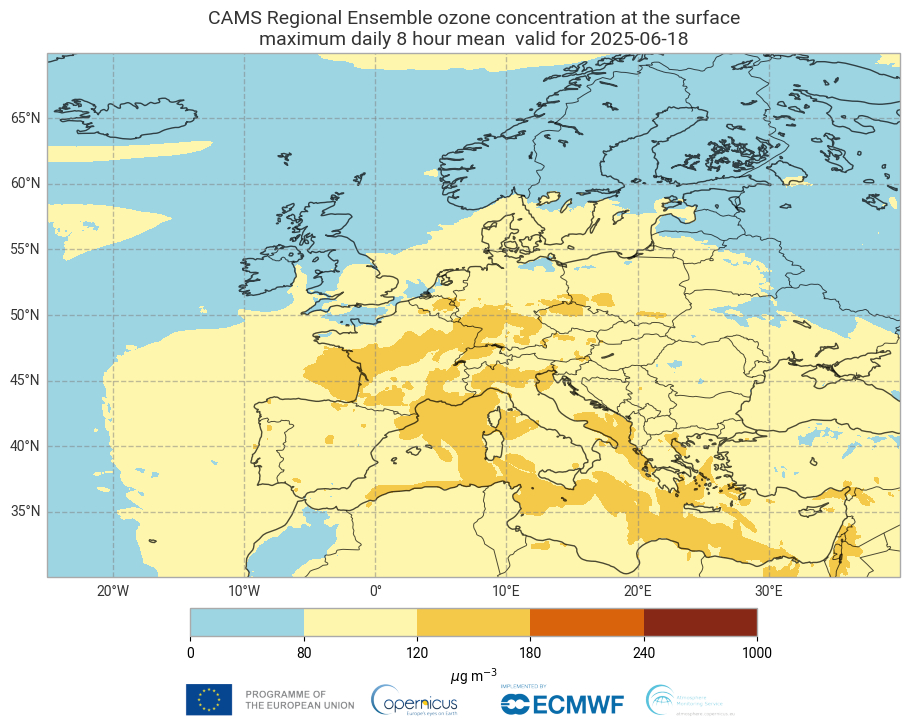
CAMS regional ensemble hourly analysis of surface ozone concentrations between 9 June and 21 June 2025, showing the diurnal cycle of tropospheric ozone. Credit: Copernicus Atmosphere Monitoring Service/ECMWF
With the onset of summer and the associated increase in temperature, ground-level ozone (or tropospheric ozone) has been increasing significantly in Europe in June 2025. TheCopernicus Atmosphere Monitoring Service(CAMS) has been forecasting the evolution of these concentrations thanks to the regional modelling chain set-up by the service, as ground-level ozone is a pollutant with harmful impacts on human health and ecosystems. These particular episodes occurred earlier than normal.
CAMS forecasts for Europe indicated rising ground-level ozone concentrations across the Mediterranean Basin since 9 June, with levels increasing significantly in nearly all European countries—excluding those on the Scandinavian Peninsula. While higher ozone concentrations during the European summer are not uncommon, episodes of this intensity so early in the season are unusual. This trend is likely linked to the relatively high temperatures experienced across the continent in recent weeks.
During this episode, ozone levels in several areas exceeded the thresholds established by the European Council to protect human health against harmful effects of this pollutant.The revised Ambient Air Quality Directive (EU/2024/2881), adopted in November 2024, sets a target value to protect human health: the maximum daily eight-hour mean should not exceed 120 µg/m³ more than 18 times per calendar year. The Directive also defines an information threshold of 180 µg/m³ for the hourly mean.
“Increases in temperatures are one of the main factors explaining ground level ozone concentrations increase. Ozone results from photochemical reactions that transform pollutants emitted by human activities and natural sources. Long range transport of this pollutant plays an important role as well. CAMS provides Europe with the best available tools to monitor and forecast the evolution these episodes and provide timely alerts, which are essential for implementing agile and appropriate measures to mitigate health risks and environmental impacts.”Laurence Rouil, Director of the Copernicus Atmosphere Monitoring Service
Ground level ozone (or tropospheric ozone) results from complex photochemical reactions, stimulated by sunlight, involving nitrogen oxides (NOx) and volatile organic compounds (VOCs). Both precursors are emitted by human activities (transport, industry, residential), but some VOCs are also emitted by vegetation.