- Wildfires in Spain
- Wildfires in Portugal and France
- Wildfires in North America
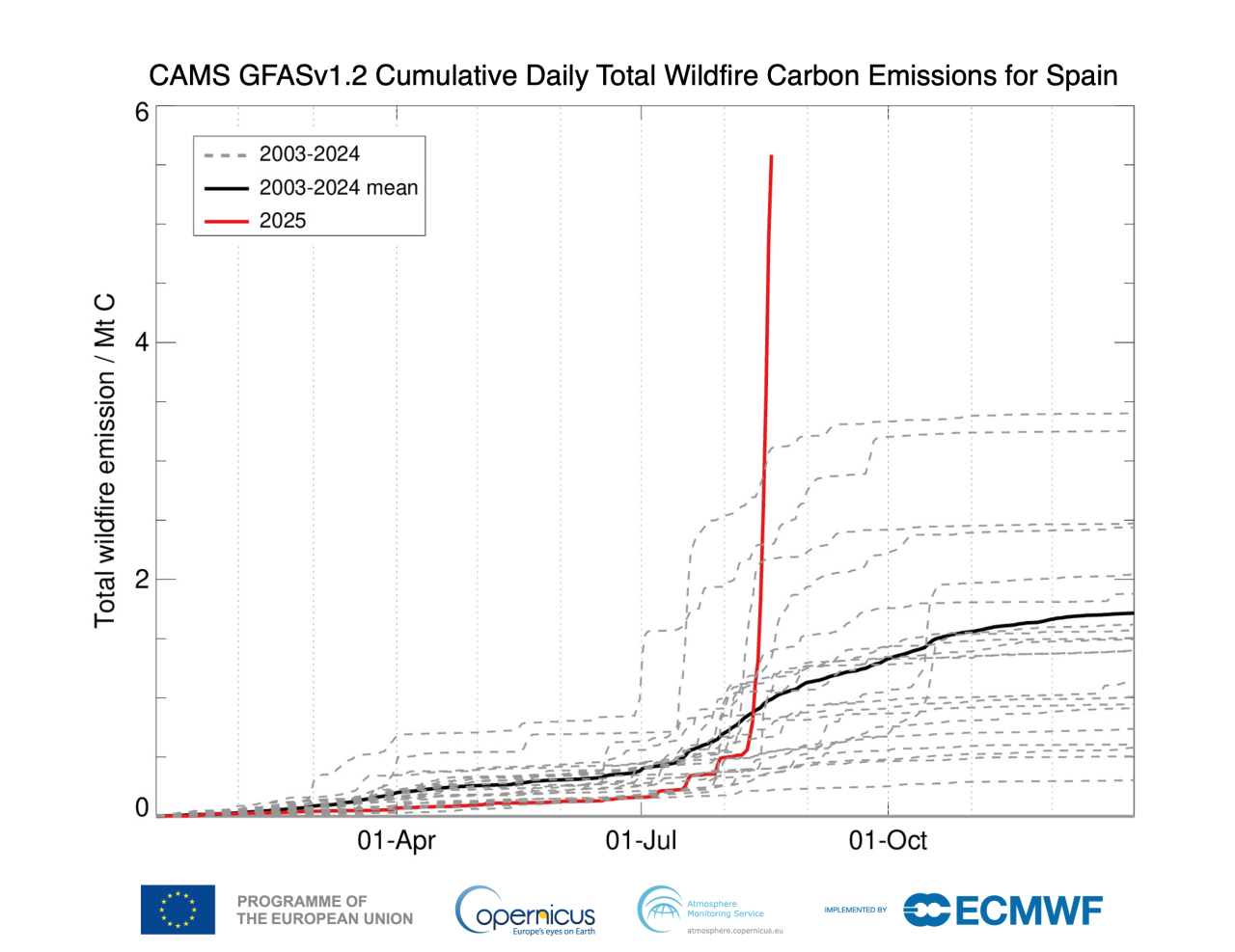
Cumulative total estimated wildfire carbon emissions for Spain from 1 January to 18 August 2025 (red line) from the CAMS Global Fire Assimilation System (GFAS). The black line is the 2003-2024 average, and the dotted grey lines are the emissions in each of the previous years from 1 January to 31 December for each year. Credit: CAMS/ECMWF
TheCopernicus Atmosphere Monitoring Service (CAMS)has been closely monitoring the exceptional surge in wildfire emissions across Spain and Portugal during the first half of August. At the beginning of the month, the cumulative wildfire carbon emissions for Spain were below the seasonal average, despite several active fires. Within just a few days, however, unprecedented fire activity in multiple regions drove the country’s total wildfire emissions for 2025 up to become the highest annual total in the 23 years in the CAMS dataset.
Wildfires in Spain
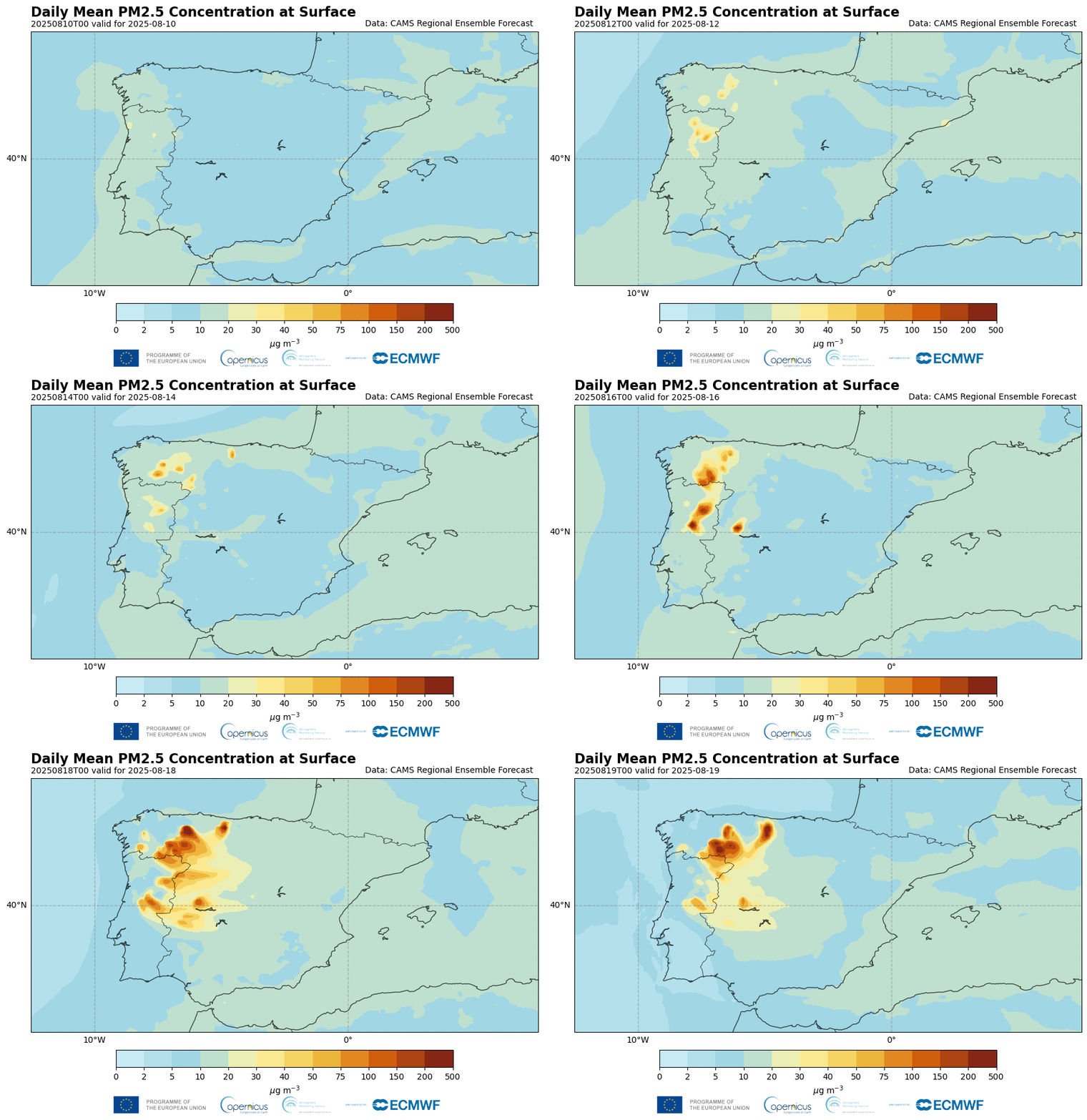
Several regions in the north-west of Spain, including Castilla y León, Galicia, Asturias and Extremadura, have been heavily affected by the recent wildfires. Thousands of residents were evacuated, transport links such as the Madrid-Galicia train line were interrupted, and many roads remained closed. The observations from the Spanish air quality monitoring network and CAMS forecasting and monitoring system show that air quality across a large region of Spain has deteriorated, with fine particulate matter PM2.5 concentrations well above World Health Organization air quality guidelines (which is a 24-hour mean of 15 μg/m3 for PM2.5). Smoke has travelled hundreds of kilometers, reducing air quality far beyond the immediate fire zones.
Wildfires in Portugal and France
Wildfires continued through the first weeks of August in northern Portugal with additional large fire developing in central Portugal in recent days. CAMS forecasts showed a clear increase in surface PM2.5 linked to smoke from these fires, with concentrations well above normal levels. Smoke from the fires across the Iberian Peninsula has travelled across France, the UK and into Scandinavia, adding to smoke from Canadian wildfires crossing the Atlantic. In France, the extreme heat has maintained a very high fire risk. On the 4 August, a major wildfire developed in the Aude department, between Carcassonne and Perpignan. It was the worst fire in the French Mediterranean in half a century.
“The wildfire emissions from Spain and Portugal during August has been exceptional. The growth in the total estimated emissions from below averages to reach the highest annual total for Spain in the two decades of the CAMS fir emissions dataset in just 7-8 days. The large quantities of smoke, and especially PM2.5, released into the atmosphere have resulted in severely degraded air quality locally and further afield across the Iberian Peninsula and parts of France. Through our continuous monitoring, CAMS provides essential information to understand these developments and support responses to their impacts.”Mark Parrington, Senior Scientist of the Copernicus Atmosphere Monitoring Service, explains
Wildfires in North America
Across the Atlantic, North America is also experiencing widespread fire activity. In Canada, the provinces of Saskatchewan and Manitoba remain the most affected, with 2025 already ranking as the country’s second most severe fire season on record after 2023. While in the US, fires in Nevada, Arizona, Utah and Colorado have continued since July, producing major smoke plumes.
As the hot and dry conditions across southern Europe and North America continue, CAMS will keep monitoring the scale and spread of wildfire activity, providing vital information to support preparedness and response measures.