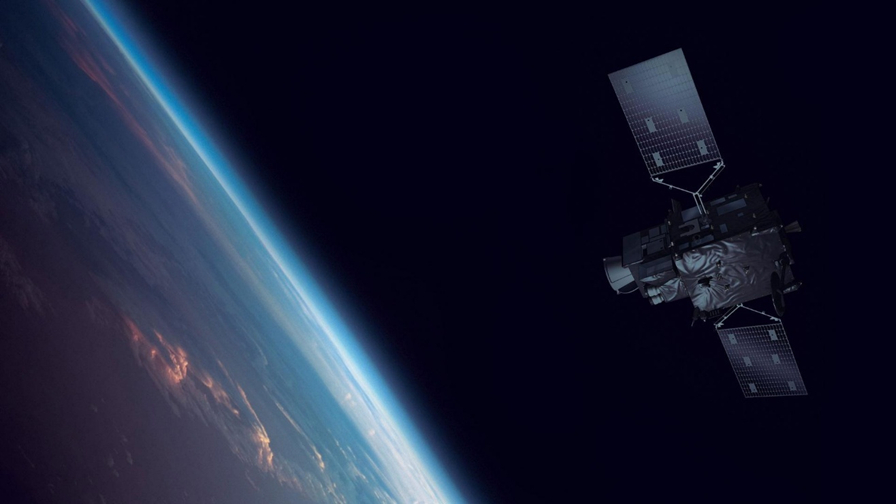
Sentinel-4 will be hosted onboard EUMETSAT’s MTG-Sounder (MTG-S) satellite and work in synergy with its Infrared Sounder (IRS) instrument. Credit: EUMETSAT.
With the launch of the Sentinel-4 satellite, the capabilities of theCopernicus Atmosphere Monitoring Service (CAMS)for air quality monitoring will increase significantly. This will be the first European instrument dedicated to air quality monitoring to be launched on a geostationary satellite, complementing current low Earth orbiting satellite instruments and maintaining Europe’s position at the forefront of atmospheric monitoring. The mission is implemented and operated by the European Space Agency (ESA) and the European Organisation for the Exploitation of Meteorological Satellites (EUMETSAT).
Equipped with an ultraviolet, visible and near-infrared imaging spectrometer, Sentinel-4 will be in a geostationary orbit at 36,000 km above the Earth, 50 times higher than low Earth orbit missions, constantly observing Europe’s air quality with hourly scans. This is a great improvement, as the current Copernicus missions relevant for air quality can only produce a single image of Europe per day. The new Sentinel-4 data will allow CAMS to enhance their air quality forecasts and analyses for Europe. Some of the pollutants tracked through this instrument are nitrogen dioxide (NO₂), ozone (O₃), sulphur dioxide (SO₂), formaldehyde (HCHO), and aerosols.
It measures levels of major air pollutants, such as the toxic trace gases nitrogen dioxide, which is formed when fossil fuels are burned, and ozone, which is typically produced downwind of the pollution sources.
It is also a first for a Sentinel mission to “share” a spacecraft, since the Sentinel-4 mission is mounted on a Meteosat Third Generation satellite, which also carries instruments for improved weather monitoring and forecasting.