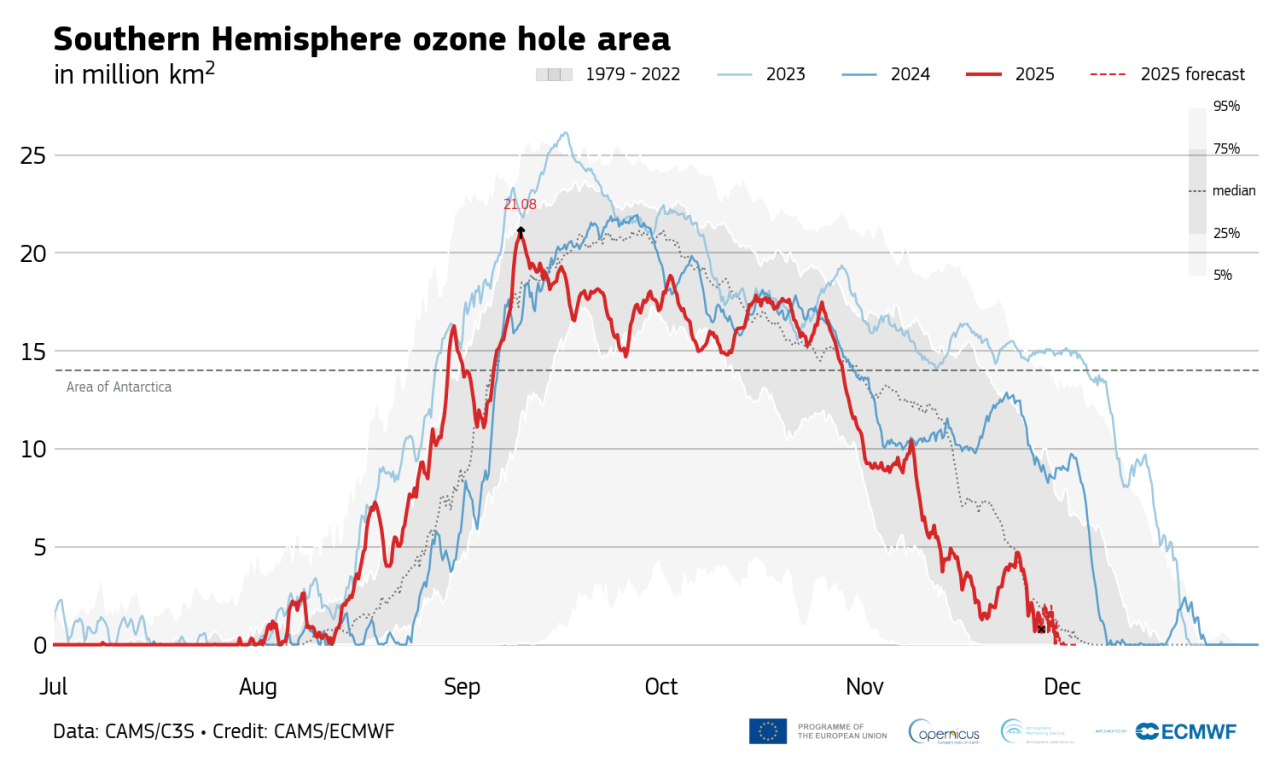
Daily evolution of the 2025 (red) Southern Hemisphere ozone hole area poleward of 60°S in million km2compared with 2024 (dark blue), 2023 (light blue) and the statistical spread of 1979-2022 (grey shading). Data source: CAMS/C3S. Credit: CAMS/ECMWF.
The Copernicus Atmosphere Monitoring Service (CAMS) today confirms that the 2025 Antarctic ozone hole has come to an end on 30 November, marking the earliest closure since 2019. The 2025 ozone hole was also the smallest in five years, marking the second consecutive year of relatively small holes compared to the series of large and long-lasting ozone holes from 2020-2023, and had higher ozone concentrations, fueling hopes for recovery.
Each year, the ozone hole season – during austral spring – is shaped by temperatures and winds in the stratosphere over the Southern Hemisphere and the presence of human emitted Ozone Depleting Substances (ODS).
“The earlier closure and relatively small size of this year’s ozone hole is a reassuring sign and reflects the steady year-on-year progress we are now observing in the recovery of the ozone layer thanks to the ODS ban. This progress should be celebrated as a timely reminder of what can be achieved when the international community works together to address global environmental challenges.”Laurence Rouil, Director of the Copernicus Atmosphere Monitoring Service
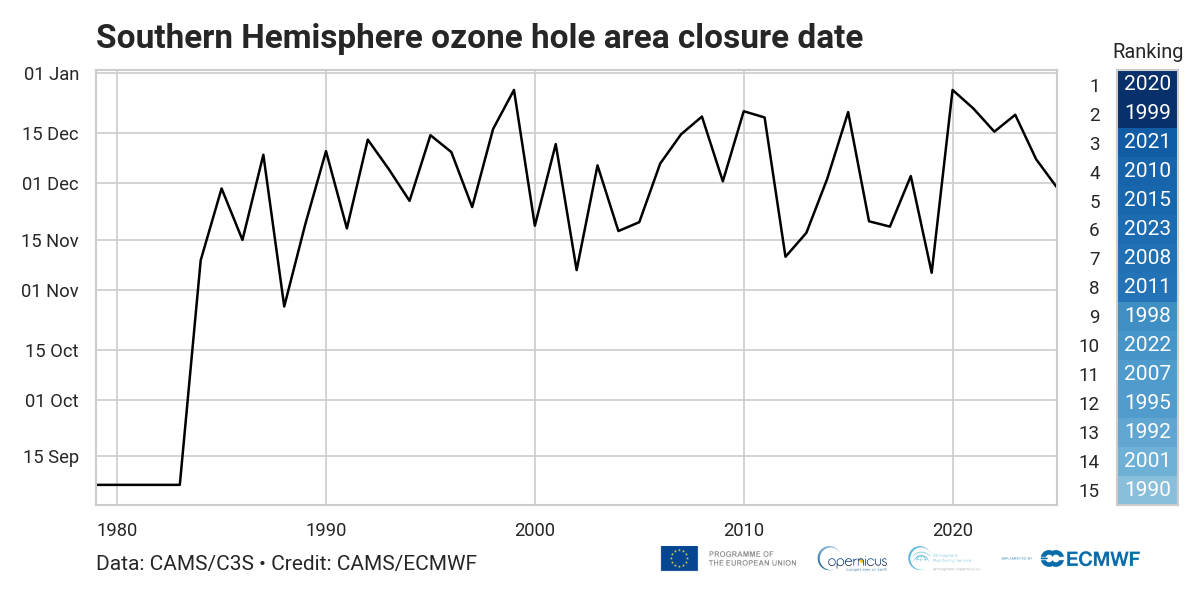
Closure dates of the Antarctic ozone hole since 1979 (line chart) and ranking of the earliest closure dates (table).
In 2025 the ozone hole developed relatively early through mid-August, following a similar trajectory to the large ozone hole of 2023. In early September it reached its maximum area for the season, 21.08 million km2– well below the historical maximum of 26.1 million km2observed in 2023.
Through September and October its size remained considerable, between 15 million km2– roughly the area of Antarctica – and 20 million km2. The area of the ozone hole declined quickly during the first half of November, indicating the possibility of an early closure. However, a persistent small area of low ozone persisted through the second half of the month, until it fully closed on the xxth.
Compared to recent years, the 2025 ozone hole showed higher than average ozone column minimum and lower ozone mass deficit, indicating higher ozone concentrations in the Antarctic stratosphere.
The larger and longer-lasting holes between 2020-2023 are a reminder that the ozone decline could have reached catastrophic dimensions without the concerted action of theMontreal Protocol on Substances that Deplete the Ozone Layer, and its subsequent amendments, which regulates the production and consumption of ODS, which include around 100 ozone-hole damaging chemicals such as chlorofluorocarbons (CFCs).
To read a full analysis of the 2025 ozone hole and what it means, read an article from the CAMS team here:
Smallest and shortest-lived ozone hole in 5 years closes
– End –
About CAMS
The Copernicus Atmosphere Monitoring Service (CAMS) provides consistent and quality-controlled information related to air pollution and health, solar energy, greenhouse gases and climate forcing, everywhere in the world.
CAMS is one of six services that formCopernicus, the European Union’s Earth observation programme which looks at our planet and its environment for the ultimate benefit of all European citizens. Copernicus offers information services based onsatellite Earth observation, in situ (non-satellite) data and modelling.
CAMS is implemented by theEuropean Centre for Medium-Range Weather Forecasts(ECMWF) on behalf of theEuropean Commission. ECMWF is an independent intergovernmental organisation supported by 35 states. It is both a research institute and a 24/7 operational service, producing and disseminating numerical weather predictions to its member states.
To provide and further develop the CAMS portfolio, ECMWF works with manyservice providersaround Europe. By doing so, CAMS combines the expertise and infrastructure that exist in Europe to provide a range of services that are unequalled by any other organisation in the world. CAMS also coordinates theCopernicus Health Hubon behalf of the Copernicus Programme and its Services.
To acquire all the observations that are needed to produce the CAMS services, ECMWF collaborates with theEuropean Space Agency(ESA) and theEuropean Organisation for the Exploitation of Meteorological Satellites(EUMETSAT) as well as many other organisations providingsatellite and in-situ observations.