- Wildfires surge around the Northern hemisphere
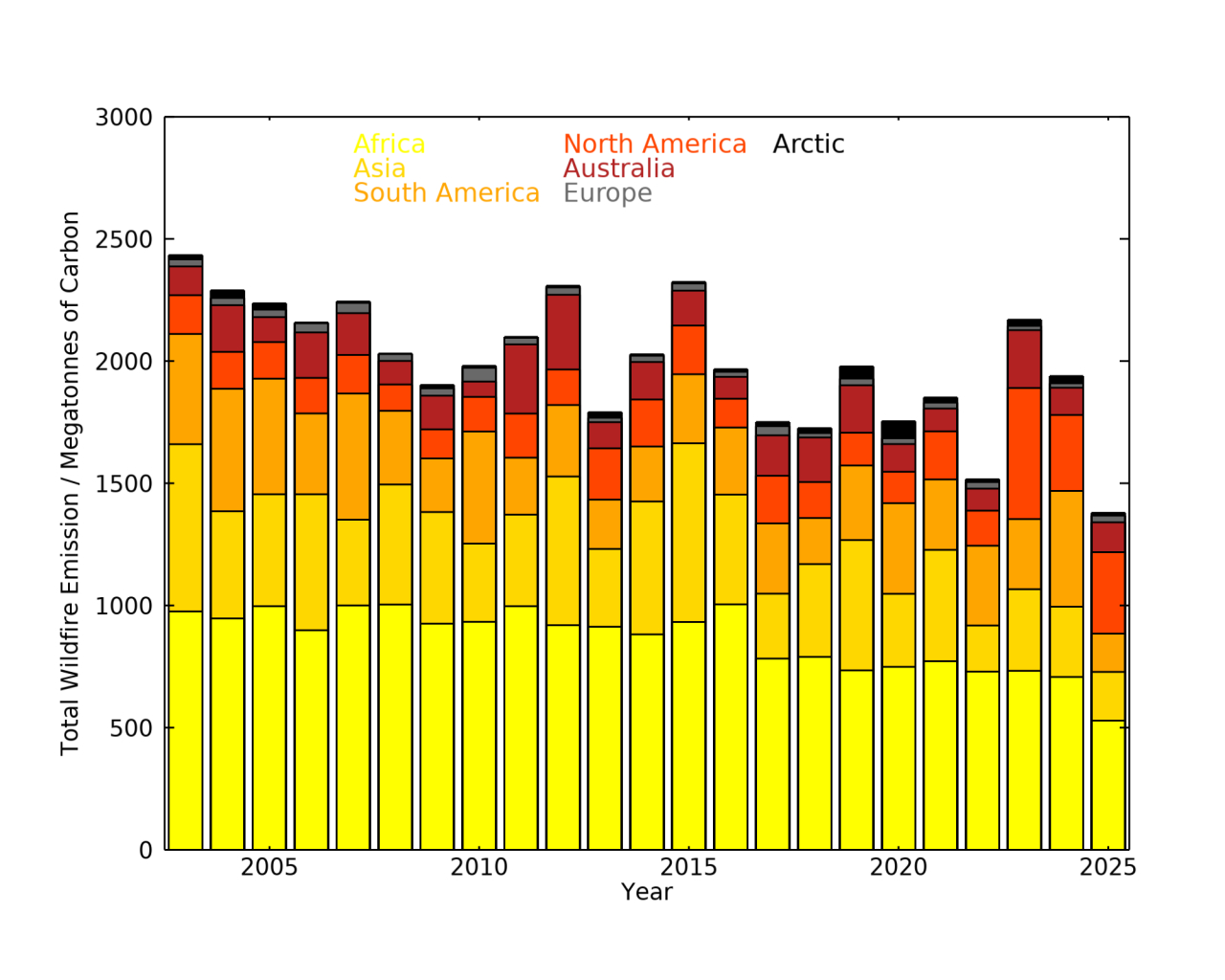
Annual global total estimated wildfire carbon emissions from 2023 to 2025. Source: Copernicus Atmosphere Monitoring Service / ECMWF
The regular monitoring of wildfire emissions carried out by the Copernicus Atmosphere Monitoring Service (CAMS)* throughout 2025 has observed significant activity in several regions of the world. Europe experienced its highest annual total emissions since CAMS records began in 2003 and Canada endured its second-highest yearly emissions. Biomass burning in tropical Africa remains the largest contributor to global biomass-burning emissions.
Significant wildfires across Europe throughout the summer period contributed to the highest annual total fire emissions of the past two decades for the European Union and the UK, at just under 13 megatonnes of carbon. While carbon emissions from fires in Europe are not significantly contributing to global CO2emissions, the numbers can be used as a proxy for the fire emissions of many pollutants that affect air quality in the region, for example, PM2.5 and nitrogen oxides (NOx).
In the Iberian Peninsula, persistent heatwaves, extremely dry conditions and strong winds drove large wildfires in Spain and Portugal. Spain saw its highest annual fire emissions in 23 years and went from below average to record emissions in just one week in mid-August. Smoke from the blazes travelled as far as the UK and northwestern Europe. Surface concentrations of fine particulate matter air pollution (PM2.5) – which has harmful impacts on human health – far exceeded the World Health Organisation’s 24-hour average guidelines.
The UK also experienced its highest annual total wildfire emissions in the 23 years of the CAMS fire emissions dataset, driven by significant wildfires in Northern Scotland in late June and early July.
Summer wildfire activity across the eastern Mediterranean was exceptionally severe, with Greece and Turkey both experiencing major outbreaks from late June into July. Cyprus endured its worst July wildfires in over fifty years and saw its highest annual emissions on record after just two days of burning.
Daily fire locations, intensity and smoke plumes around the world between 1 January and 30 November 2025 based on CAMS GFAS and organic matter aerosol optical depth forecasts. Source: Copernicus Atmosphere Monitoring Service / ECMWF
DOWNLOAD HIGH RESOLUTION VIDEO
Countries across the Balkan region including Albania, Montenegro, North Macedonia and Serbia experienced extreme fires during the summer.
Wildfires surge around the Northern hemisphere
Extreme wildfires persisted across boreal regions of North America in 2025. In Canada, around 250 megatonnes of carbon were released from wildfires by 1 October – marking its second highest annual emissions and third consecutive year of exceptional wildfire activity. Smoke from these wildfires repeatedly blanketed large parts of North America and there were several instances of smoke travelling across the North Atlantic to Europe and beyond.