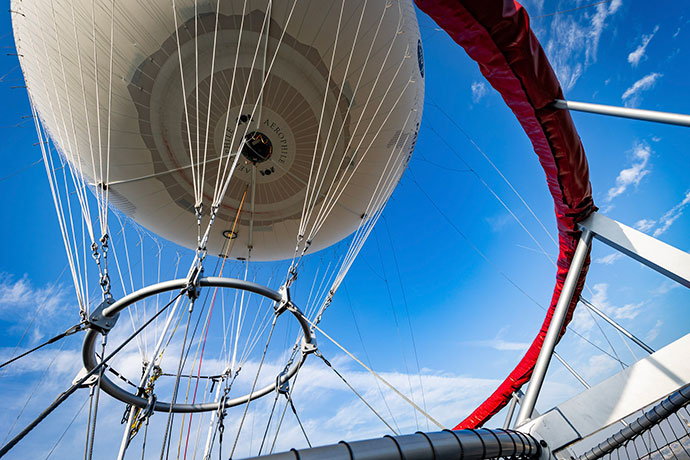
Credit: Aerophile - Hervé Thouroude
In a world of increasing weather and climate extremes, it is more important than ever for organisations to work together globally, to help make societies safer, better prepared, and more resilient.
OnWorld Meteorological Day(23 March), run by the World Meteorological Organization (WMO), ECMWF is joining forces withMétéo-Franceand theBallon Generali de Paristo highlight the essential role of weather prediction in protecting lives and strengthening climate resilience.
With the theme of this year’s World Meteorological Day being ‘Observing today, protecting tomorrow’, the organisations are uniting to demonstrate how international scientific excellence and national operational expertise benefit society.
The collaboration builds on an invitation extended to the EU’sCopernicus Climate Change Service (C3S)and theCopernicus Atmosphere Monitoring Service (CAMS), both implemented by ECMWF, tojoin the Ballon Generali de Paris as scientific collaborators last spring.
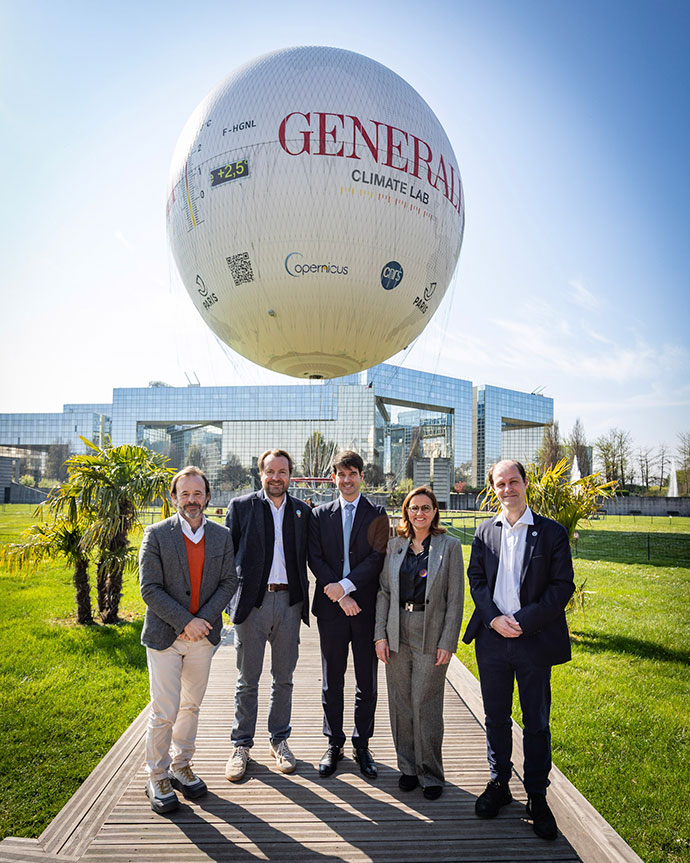
Ballon Generali de Paris (L-R): Matthieu Gobbi (CEO of Aerophile), Jérôme Giacomoni (President of Aerophile), Simon Blaquiere (Director of the Generali Climate Lab), Virginie Schwarz (President and CEO of Météo-France), Matthieu Chevalier (Head of Forecasts Evaluation at ECMWF). Credit: Aerophile - Hervé Thouroude
Global observations
ECMWF receives 800 million observations daily, with 60 million quality-controlled observations available for use in its models and products every day. These observations – drawn from satellite measurements to sea-surface temperature monitoring – are used to create initial conditions for modelling and to simulate how those conditions may play out in a range of scenarios.
Using both traditional physics-based modelling and artificial intelligence (AI)-driven models co-developed with Météo-France and other Member and Co-operating State partners, these data, which include temperature, wind and rainfall measurements, produce forecasts on a range of timescales from the medium range (four days to two weeks) through sub-seasonal (up to six weeks) to seasonal (six weeks to a year).
Observational data and modelling systems are essential not only for weather forecasting but for understanding and analysing climate change from both a global and regional perspective.
Meteorological and hydrological services and associated consortia across ECMWF’s Member and Co-operating States, including Météo-France, combine ECMWF’s data with their own observations and models to produce local forecasts that inform decision-making across civil protection, aeronautics, agriculture, energy, transport and insurance, as well as for the general public.
At the Ballon Generali de Paris, visitors can now explore three climate indicators produced by ECMWF through the framework of C3S, helping connect scientific information with public understanding.
Météo-France has also released new data showing that in 2025, the average temperature recorded in France was 2.5 °C above the average value of the pre-industrial era, due to the combined effects of global warming and natural year-to-year variability.
Virginie Schwarz, President and CEO of Météo-France explaining how partnerships and AI frameworks like Anemoi are transforming forecasts, improving climate resilience, and helping societies prepare for more extreme weather.
A shared scientific engine: IFS and ARPEGE
At the heart of the collaboration between ECMWF and Météo-France is the Integrated Forecasting System (IFS/ARPEGE), a global numerical weather prediction system jointly developed and maintained by both institutions for the benefit of ECMWF’s 35 Member and Co-operating States.
The system combines advanced atmospheric dynamics, physical modelling, and cutting-edge data assimilation techniques to produce some of the world’s most accurate global forecasts.
The IFS is ECMWF’s operational global system, underpinning physics-based forecasting and analysis across medium-range, sub-seasonal and seasonal timescales, as well as global atmospheric composition forecasts for CAMS and the ERA5 global climate reanalysis for C3S.
At Météo-France, the same codebase runs as ARPEGE – optimised with a variable-resolution grid to enhance national performance, run rapidly after observations are collected, and deliver tailored services.
In practice, both centres rely on the same core meteorological engine, with configurations adapted to their respective missions: global medium-range forecasting at ECMWF and four-day operational forecasting at Météo-France.
In addition, Météo-France’s regional model, AROME, is based on the same codebase in a specific configuration, co-developed with 26 partners in the ACCORD consortium.
Matthieu Chevallier, Head of Forecasts Evaluation at ECMWF explaining why collaboration matters – from IFS-ARPEGE and Anemoi to delivering trusted forecasts that protect people and critical sectors.
Forecasts that save lives
World Meteorological Day provides an opportunity to celebrate this long-standing partnership and recognise the generations of scientists whose work underpins today’s forecasting capability.
“The societal value of global forecasting is immense and profound in protecting life and property, ARPEGE and the IFS along with other regional models across Europe that have stemmed from it, are powerful examples of European scientific cooperation at its best and help ensure that cutting-edge science translates into timely, trusted warnings for our citizens. Our move earlier this month to make the portable version of our forecasting system fully open source, only serves to broaden the opportunity to use these shared assets for maximum benefit for all interested sectors from academia to industry.”Matthieu Chevallier, Head of Forecasts Evaluation at ECMWF